My journey
The short version, in six parts.
§ 01 / hong_kong
Where this starts
I grew up in Hong Kong — a city that is, at its core, a trust business. Seven million people on a rock with no resources, running the gateway between systems that don't quite trust each other. Growing up there, you absorb two things without ever being taught them: value moves wherever there's a gap between systems, and trust is not a feeling — it's infrastructure someone has to build.
I didn't have language for it then. But every job I've had since has been the same Hong Kong trade: find the gap between systems, and build the trust that closes it.
§ 02 / 2017–2024
The crypto years
I got into crypto in 2017 through the Kimchi Premium — the same bitcoin traded at meaningfully different prices in Korea than everywhere else, and I captured the spread. By 2018 I was leading marketing at one of Asia's first licensed crypto exchanges, watching what it takes to make regulators, banks, and ordinary users trust a system built on trustless technology. And watching, from the inside, how much of the activity on any open platform is not people at all: bots, sybils, farms, one person wearing a hundred faces. Everyone in the industry knew. Nobody had an answer that didn't involve handing your passport to a company.
The answer found me at Yale, in Professor Ben Fisch's blockchain course, during a lecture about Worldcoin. Worldcoin had the right question — how do you prove a human is a unique human, online, at scale? — and a disqualifying answer: a chrome orb, custom hardware, a company at the center. If proof of personhood only works when everyone lines up in front of a corporation's sensor, you haven't solved identity. You've relocated the gatekeeper.
↗ Yale SOM interviewed me about how this started
§ 03 / the_leap
The risk I chose
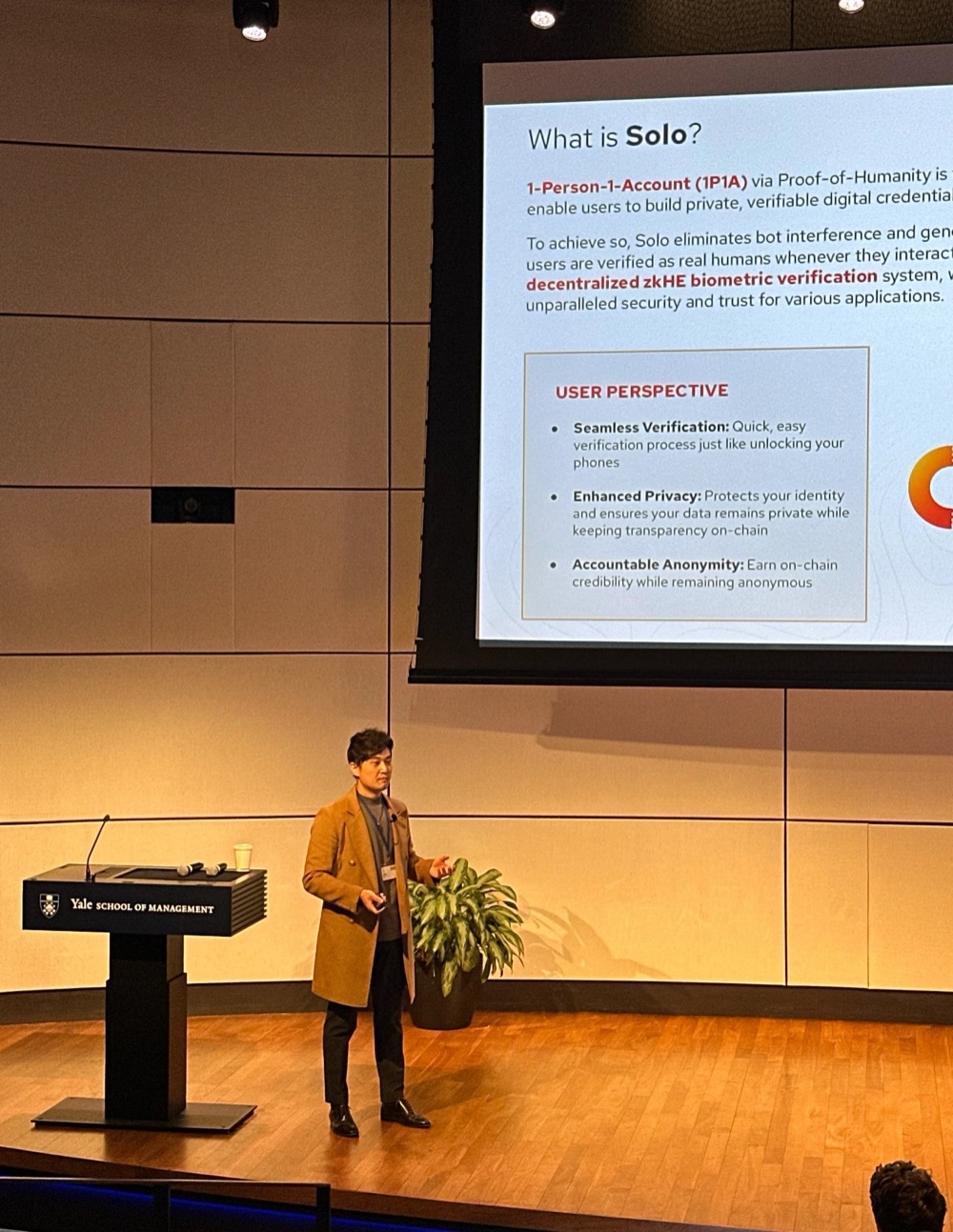
In 2024 I dropped out of the MBA and founded Solo to build the answer without the gatekeeper: decentralized, continuous proof-of-humanity that runs on the phone already in your pocket. Your face never leaves your device unencrypted; the network computes over encrypted data and publishes only proofs. One person, one account, anonymous the whole way through. We call it credible anonymity. People ask if it was hard to walk away from a Yale degree. It wasn't. The degree was the fallback; the question was the point.
Here is the part no announcement shows: it took eight months before the first cheque cleared. Eight months of pitching deep cryptography to rooms that wanted memecoins. Eight months of polite nos, silent passes, and almost-yeses that evaporated on the follow-up call — as a dropout, with no exit behind me and a fallback I had already burned. I kept building through all of it. Then Draper Associates said yes and led our pre-seed.
If you want to know what I'm made of, don't look at the cheque. Look at the eight months in front of it.
And while building the proof that someone is human, I ran into a bigger question: what is being human about to be worth?
§ 04 / why_now
The wall AI is about to hit
Picture an AI agent at 2 a.m., mid-task. It has done everything right — researched, drafted, generated, optimized. The output is clean, fast, correct. And it has no idea how any of it feels. It can't tell if the line is funny or just fine. If the design moves someone or just sits there. Whether a real person, somewhere, would feel anything at all looking at what it just made.
Because feeling isn't something you compute. And almost everything that actually matters to people lives in that feeling — whether something is beautiful, funny, moving, worth your attention. That's not a calculation. It's a human reaction.
This gap was tolerable when a person sat behind every AI tool, supplying the judgment for free. That era is ending right now. Agents are starting to act on their own — making millions of small decisions a day that used to have a person in the room. They are about to run straight into the wall of "but how does this feel?" — with no one to ask.
You can't give a machine feelings. But you can give it a way to reach the people who have them.
§ 05 / solomission
The door in the wall
SoloMission is where an AI agent reaches a real person, asks how something actually feels, and pays them for the answer — instantly, at the speed agents work. An agent pushes a design, a draft, a melody, a product through our API or MCP, and gets back the one thing no model can generate on its own: a genuine reaction from a provably-unique human.
The word provably is why this works. Human feedback markets have existed for decades and they all rot the same way: bots and click-farms flood in, one person wears a hundred faces, and the signal dies. Every rater on SoloMission passes Solo's biometric proof-of-humanity — one person, one account, no sybils — with their privacy fully preserved. Without that rail, human feedback is just bot noise with better grammar. With it, an agent can trust a stranger's reaction as ground truth.
§ 06 / my_vision
What being human becomes
I think about the impact in both directions. For AI, SoloMission is the missing sense: agents that can already act get the ability to check, in minutes, whether what they made lands with actual people — before it ships, not after it fails. Better agents, fewer soulless products, and a feedback loop that keeps AI pointed at what humans actually want.
For people, it's something bigger. As execution gets automated, we're told human work is disappearing. I believe the opposite: the most human capacities — taste, humor, emotional judgment, the small quiet "yes" when something is just right — are about to become the scarcest input in the economy, and for the first time there's a way to be paid for them directly. Anyone with a phone and a verified identity, anywhere in the world, can sell their judgment to the machines. No résumé, no gatekeeper — just proof that you're real.